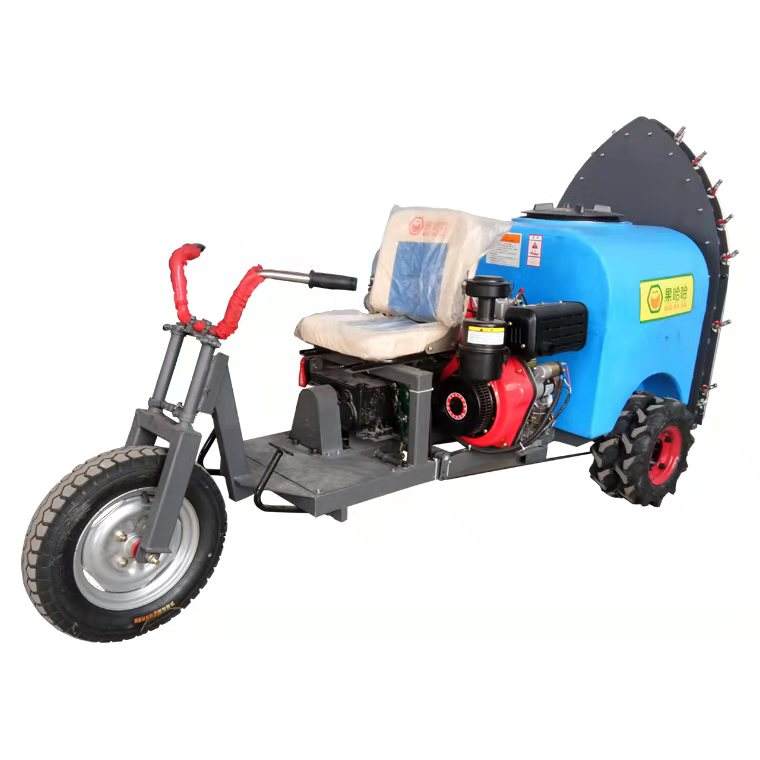
Self-propelled orchard sprayers come in two layouts: a single front steered wheel with two rear drive wheels, or four wheels with rear steering. Both carry 300 L to 500 L and both run an air-blast head. The difference shows up in the headland, not on the spec sheet.
Turning inside the headland
A three-wheel machine pivots around the front wheel. In a 4 m row with a 4 m headland, it can turn back into the next row in one movement. A four-wheel machine with rear steering turns tighter than a tractor but still needs about a metre more than the three-wheel layout, which is the difference between one pass and a three-point turn at every row end.
- Three-wheel: tightest turn, best for rows under 4.5 m and headlands under 5 m.
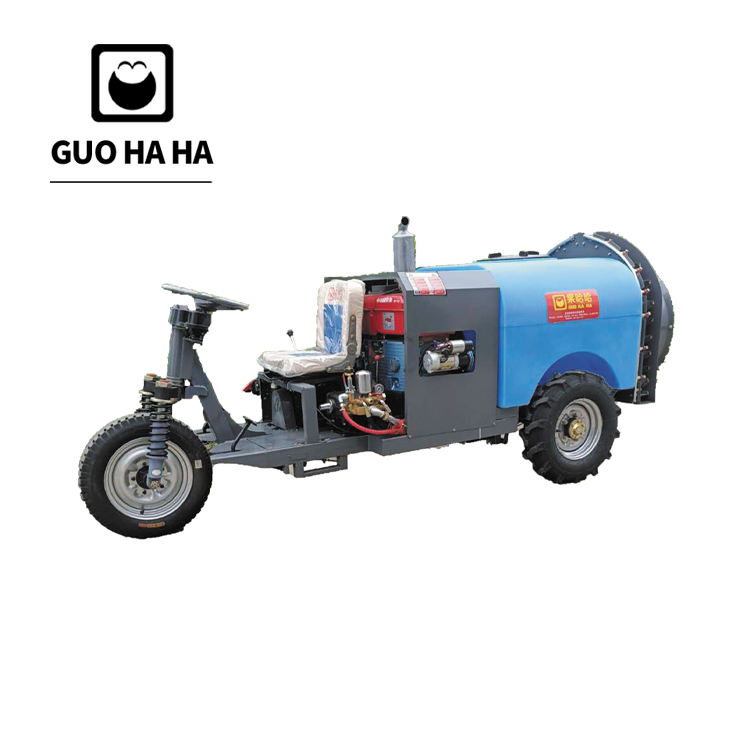
- Four-wheel: more stable on side slopes, better on gravel tracks and long road moves.
- Both: check the track width against the row, not the overall width against the gate.
Stability on slopes
On a cross-slope above 12 degrees, the four-wheel layout keeps both uphill wheels loaded and resists the sideways roll that a three-wheel machine answers with a wider track. Growers on terraced ground usually accept the longer turn to get that stability, or move to a crawler with a much lower centre of gravity.
Tyre choice follows the same logic. Bar tyres grip on damp grass but mark a wet headland; turf tyres are gentler but spin on a 15 degree climb with a full tank.
Pick the machine that turns in your worst headland, not your best one.
Matching tank and engine
A 300 L tank at 300 L per hectare covers one hectare per fill, which suits blocks of 8 to 15 hectares where the water point is central. A 500 L machine covers one and two thirds hectares and is usually specified with a water-cooled diesel so it can run a full day without heat soak.
What the operator actually feels
The difference between the two layouts is most obvious at the end of a long day. A three-wheel machine with a single front wheel transmits every ridge to the steering column, and the operator corrects constantly. A four-wheel machine with rear steering tracks straighter on gravel and needs less correction, which matters over eight hours.
Service access also differs. On most three-wheel designs the engine sits behind the operator with the air head above it, so daily checks are done from the ground. On four-wheel machines the engine is usually lower and further forward, which is better for weight distribution but means the radiator screen has to be brushed from the side.
If the block is mixed — some rows at 4 m, some at 6 m — measure the narrowest and specify for that. A machine that fits the tight row can always widen its track for the open one; the reverse is not true, and the mistake only appears after the machine is delivered.
Send us your row spacing, headland width and slope, and we will tell you whether the 300 L three-wheel unit or the 500 L model is the better fit.