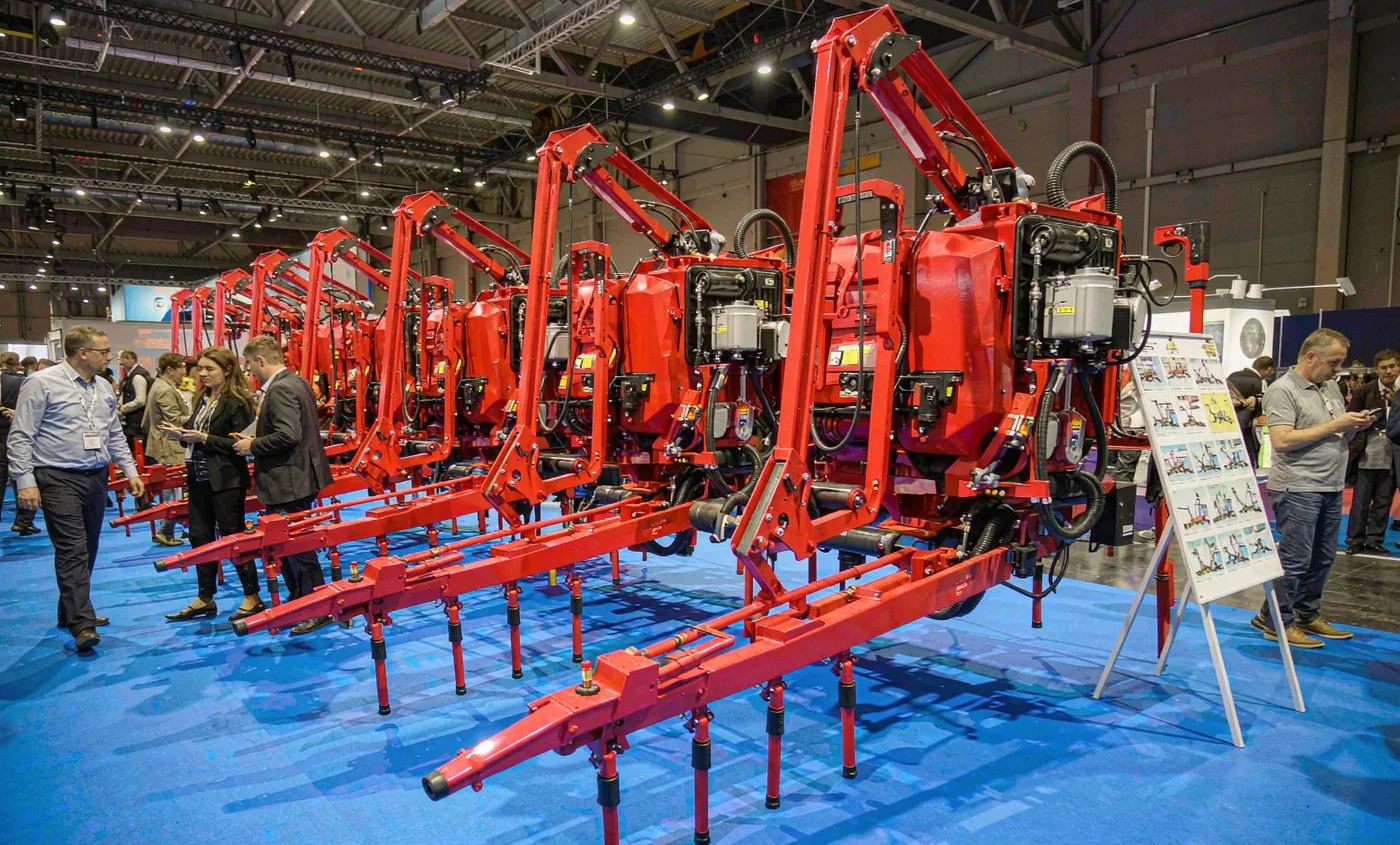
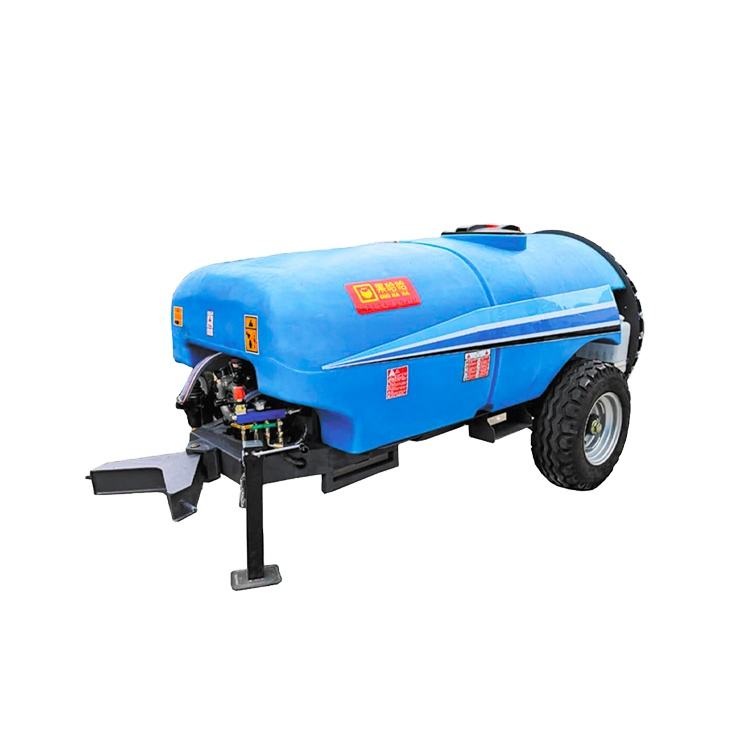
Most growers in this size band end up comparing a trailed unit against a three-point hitch machine, and the decision is usually made on tank size alone. It should not be. The machine that finishes the season is the one whose refill cycle fits the distance to water, whose width fits the rows, and whose weight the tractor can carry on the worst slope on the farm.
Start with the row, not the tank
A mounted sprayer hangs behind the rear axle. On a 4 m row spacing with a 12 m spray swath, the extra weight helps traction on a damp hillside, and the short wheelbase turns inside a tight headland without a three-point turn. Narrow that row to 2.5 m and add a 600 L tank full of water, and the same machine starts to lift the front axle on a climb.
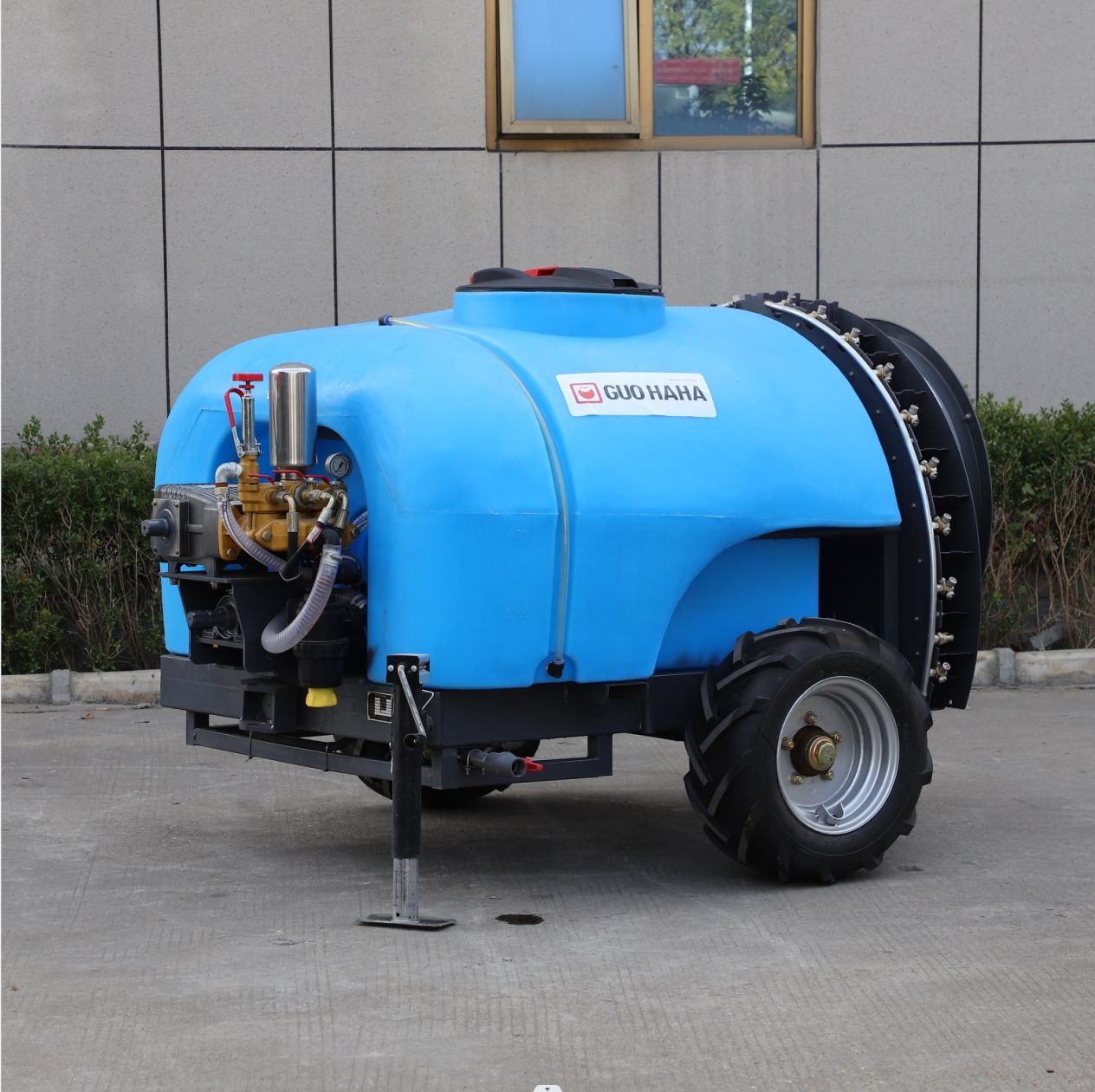
Trailed units carry their own axle, so the tractor only pulls. That is why they take 1,000 L to 2,000 L tanks without changing the tractor, and why the pump can run at full pressure while the tractor idles between fills.
- Measure the narrowest row and the tightest headland before comparing litres.
- Check the tractor's rear lift capacity, then subtract the boom and the tank at full water weight.
- Count the refill trips per day on a trailed unit: distance to water times trips is the real cost.
Where the trailed machine wins
Once a block passes roughly 15 hectares of continuous rows, the refill stop becomes the bottleneck. A 2,000 L trailed sprayer at 300 L per hectare covers more than six hectares per fill; a 400 L mounted unit covers about one and a third. On a farm where the water point sits at the end of the block, that difference is two hours a day.
Trailed frames also leave room for a bigger pump, a rinse tank and a 12 m boom that folds in three sections. Growers who spray both orchards and open field crops tend to keep one trailed machine and set the boom height per crop rather than owning two sprayers.
The cheapest sprayer is the one that does not make you drive back to the pump three extra times before lunch.
Where mounted still makes sense
Below about 40 hectares, or where a 40 to 60 hp tractor is the only machine available, a 200 L to 600 L three-point hitch sprayer is quicker to hitch, easier to store and cheaper to insure. It also lets one tractor carry a mower in the morning and a sprayer in the afternoon without a second trailer in the yard.
On terraces and very steep blocks the argument flips again: a mounted unit follows the tractor's line, while a trailed tank can push the rear of the tractor sideways on a wet contour. This is where a crawler or a self-propelled machine usually replaces both.
Cost of ownership over five seasons
The purchase price of a 1,000 L trailed sprayer is roughly twice that of a 400 L mounted unit, but the difference narrows once labour is counted. If the mounted machine needs two extra refill trips a day at fifteen minutes each, that is thirty hours a season, and thirty hours of a skilled operator usually costs more than the price gap.
Wear parts are similar across both layouts: nozzles, diaphragms, filters and hoses. Where they differ is tyres and axles, which only the trailed machine has, and lift components, which only the mounted machine loads. Budget for one axle bearing set and four tyres over five seasons on a trailed unit, and for a set of lower link pins on a mounted one.
Tell us your row spacing, block size and the distance from the water point, and we will quote the tank size and boom width that fit. See the 1,000 L trailed sprayer and the 600 L three-point hitch model.